Invisalign vs Traditional Braces
Which Treatment Is Right for You?
Invisalign vs traditional braces is probably the single most common question an orthodontist hears from adult and teenage patients alike. Both can get you to an excellent, stable result — the difference is in how they get there, which cases they’re actually suited for, and how much they ask of your daily life along the way.
Below, we go through the real comparison: how each one works, who tends to be a good fit for which, how long treatment actually takes, and the practical side of managing orthodontics as someone flying in from abroad. It’s the same comparison we walk patients through at Clinic Plus One before recommending either option. None of this substitutes for an actual orthodontic assessment, in person or through a proper digital workup, because the right answer here genuinely depends on your specific bite.
Choosing between Invisalign and traditional braces isn’t just about appearance — it’s about which system can realistically correct your specific bite in a predictable way. Some cases genuinely work equally well with either option; others clearly favor one over the other once an orthodontist looks at your crowding, rotations, and jaw alignment. That’s why this comparison walks through candidacy, day-to-day comfort, treatment timelines, and the practical logistics of managing either treatment — including what it means for patients who can’t be in the clinic every few weeks.
What Is Invisalign?
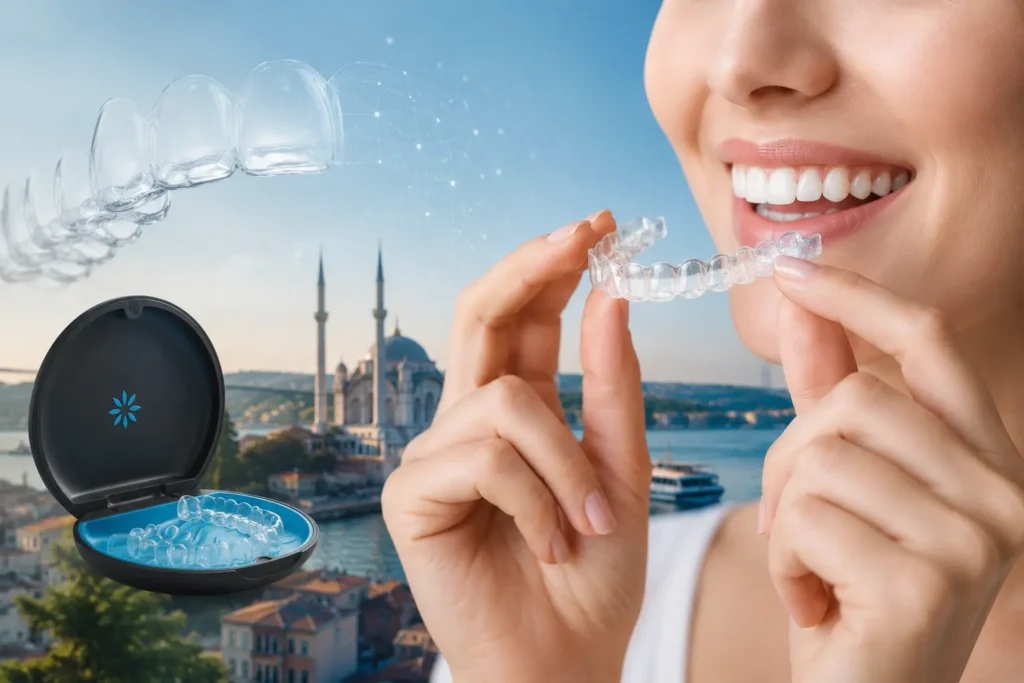
Invisalign is a clear aligner system that uses a series of custom-made, removable plastic trays to gradually move teeth into their planned positions. Each set of aligners is worn for one to two weeks before moving to the next in the series, with the total number of trays depending on the complexity of the case.
Treatment is planned digitally using an intraoral scan and simulation software (often called ClinCheck in the Invisalign system), which shows the projected tooth movement before treatment begins. The aligners themselves are made from smooth, transparent medical-grade plastic and are designed to be far less visible than metal brackets.
What Are Traditional Braces?
Traditional braces use brackets bonded to the front (or, with lingual braces, the back) of the teeth, connected by an archwire that is adjusted periodically to guide teeth into position. Braces have been used in orthodontics for decades and remain one of the most predictable and versatile treatment options, particularly for complex cases.
Modern bracket systems include:
- Metal braces — durable and widely used, the traditional option most people picture
- Ceramic (tooth-coloured) braces — a more aesthetic alternative to metal, at a similar treatment capability
- Self-ligating braces (e.g. Damon system) — using a sliding mechanism instead of elastic ties, often allowing longer intervals between adjustments
- Lingual braces — bonded to the back of the teeth, making them invisible from the front, though typically more technique-sensitive to fit and adjust
Invisalign vs Traditional Braces: Side-by-Side Comparison
| Factor | Invisalign (Clear Aligners) | Traditional Braces |
|---|---|---|
| Visibility | Nearly invisible | Visible (unless ceramic or lingual) |
| Removability | Removable for eating and brushing | Fixed for the duration of treatment |
| Best suited for | Mild to moderate crowding, spacing, minor bite issues | Mild to severe crowding, rotations, complex bite correction |
| Oral hygiene | Easier — trays are removed to brush and floss normally | More difficult — requires special brushes/floss around brackets |
| Comfort | Generally smoother, though pressure is felt with each new tray | Can cause more irritation to cheeks/lips, especially early on |
| Compliance required | High — aligners must be worn 20–22 hours per day to stay on schedule | Low — braces work continuously regardless of patient behaviour |
| Adjustment visits | Less frequent; many steps can be monitored remotely | Every 4–10 weeks depending on bracket type |
| Typical treatment time | 6–18 months for most cases | 12–24 months, longer for complex cases |
| International patient logistics | Well suited — aligner sets can often be shipped after initial scan | More challenging — requires more frequent in-person adjustments |
Who Is a Good Candidate for Invisalign?
Invisalign tends to work best for patients with:
- Mild to moderate crowding or spacing
- Minor bite issues, such as slight overbite, underbite or crossbite
- A strong ability to commit to wearing aligners 20–22 hours a day
- A preference for a discreet, removable treatment option
- No significant rotations or complex jaw discrepancies that require more mechanical control
Invisalign is not automatically the right choice for every case — more complex misalignment or skeletal bite problems may still require traditional braces or a combination approach.
Who Is a Good Candidate for Traditional Braces?
Traditional braces are often recommended for patients with:
- Severe crowding or significant gaps
- Rotated teeth, which are more difficult for aligners to correct predictably
- Complex bite problems, including significant overbite, underbite or open bite
- Jaw relationship issues that require more precise, continuous force
- Patients (particularly some younger teenagers) who may not reliably wear removable aligners for the required hours per day
When Might Neither Be Recommended (Yet)?
- Active gum disease or untreated tooth decay should be addressed before orthodontic treatment begins
- Certain skeletal jaw discrepancies may require a combined orthodontic-surgical approach (orthognathic surgery) rather than braces or aligners alone
- Patients unwilling or unable to attend any follow-up appointments — remote monitoring can reduce, but not eliminate, the need for occasional in-person checks
Natural Appearance
Strong &
Durable
Improve
Chewing
Preserve
Jawbone
Boost
Confidence
Step-by-Step: How Each Treatment Works
Invisalign Process
- Initial consultation and digital 3D scan (iTero or similar intraoral scanner)
- Digital treatment simulation, showing the planned tooth movement stage by stage
- Custom aligner fabrication based on the approved digital plan
- Wearing each aligner set for 20–22 hours daily, changing every 1–2 weeks
- Periodic check-ins, often combining occasional in-person visits with remote photo/video monitoring
- Retainer fitting once the planned tooth movement is complete
Traditional Braces Process
- Initial consultation, X-rays and impressions/digital scan
- Treatment planning, including bracket type and estimated duration
- Bonding of brackets to the teeth and placement of the initial archwire
- Periodic adjustment visits, typically every 4–10 weeks depending on the bracket system
- Progressive wire changes to guide teeth into their final position
- Bracket removal once treatment goals are achieved
- Retainer fitting to maintain the new tooth position
Digital Technology in Modern Orthodontics
- Intraoral scanners (e.g. iTero), replacing traditional impression putty for both aligners and braces planning
- Digital treatment simulation software, allowing patients to preview projected tooth movement
- 3D-printed models, used to fabricate more precise aligners or indirect bonding trays for braces
- Remote monitoring apps, which allow some progress checks to be done via photos or video calls between in-person visits — useful for international patients, though not a full replacement for periodic clinical review
Recovery, Comfort and What to Expect
| Stage | Invisalign | Traditional Braces |
|---|---|---|
| First few days | Mild pressure/tightness with each new tray | Soreness, possible cheek/lip irritation as mouth adjusts |
| Ongoing | Occasional discomfort when switching trays | Mild soreness for a few days after each adjustment |
| Eating | Trays removed for meals — no food restrictions | Some hard, sticky or chewy foods should be avoided |
| Speech | Slight, temporary lisp possible in the first days | Minimal impact once brackets are in place |
Neither treatment should cause severe or lasting pain. Persistent sharp pain, unusual swelling, or signs of infection should always be reported to your treating clinician promptly.
Aftercare for Both Treatments
- Wear retainers exactly as instructed after treatment ends — this applies to both Invisalign and braces, since teeth can shift back without it
- Maintain regular dental check-ups and cleanings throughout treatment
- Follow wear-time instructions precisely for Invisalign — inconsistent wear is the most common reason for delayed results
- Use recommended cleaning tools (interdental brushes, floss threaders) with fixed braces
- Attend all scheduled adjustment or monitoring appointments, whether in person or remote
Risks and Limitations
- Invisalign relies heavily on patient compliance — inconsistent wear can extend treatment time or produce an incomplete result
- Traditional braces can cause more irritation to soft tissue and require more diligent oral hygiene to avoid decalcification or decay around brackets
- Both treatments carry a risk of relapse (teeth shifting back) if retainers are not worn as instructed after treatment
- Complex bite or jaw discrepancies may not be fully resolved by either braces or aligners alone, and may require additional orthodontic or surgical planning
- As with any dental treatment, individual results and treatment duration vary based on case complexity and compliance
Common Mistakes Patients Make
- Assuming Invisalign is always faster — treatment time depends on case complexity, not the technology itself
- Underestimating the wear-time commitment Invisalign requires (20–22 hours daily)
- Choosing a treatment type without confirming it can actually correct the specific bite issue
- Skipping retainer wear after treatment finishes, risking relapse
- Not accounting for travel logistics — traditional braces require more frequent in-person adjustments, which matters for international patients
- Not asking how many total visits to Istanbul will be required before committing to treatment
- Modern dental technologies
- Experienced implant specialists
- Significantly lower treatment costs
- Luxury accommodation & VIP transfer
- Short waiting times
- Comprehensive patient support
Getting a Plan Built Around Your Bite
Invisalign and braces aren’t interchangeable options you pick based on preference alone. What actually moves your teeth safely and predictably depends on your crowding, your bite, and how disciplined you can realistically be with wear-time if you go the aligner route.
At Clinic Plus One, we start with a proper 3D scan and a real conversation about your case before recommending either option. If Invisalign genuinely won’t get you the result you want, we’ll tell you that directly rather than sell you the treatment that happens to be easier to deliver remotely.
Planning Around Multiple Visits as an International Patient
Unlike a single-visit cosmetic treatment, orthodontic treatment takes months to complete, which has practical implications for patients travelling from abroad:
- Invisalign is generally easier to manage remotely: after the initial 3D scan and treatment planning visit, many patients can have subsequent aligner sets shipped home, with progress monitored via photos or video calls, and only occasional return visits needed
- Traditional braces typically require in-person adjustments every 4–10 weeks, which is more challenging to manage from abroad unless you can visit Istanbul relatively often, or the clinic coordinates with a trusted dentist in your home country between visits
- Patients should ask, before starting treatment, exactly how many in-person visits will be required and how remote monitoring is handled, particularly for retainer fitting once treatment concludes
Frequently Asked Questions
1. Is Invisalign as effective as traditional braces? For mild to moderate cases, yes, generally comparable. Once you’re dealing with severe crowding, significant rotations, or complex bite problems, braces tend to be the more predictable tool.
2. Which is faster, Invisalign or braces? Neither, really — the timeline tracks the complexity of your case, not which technology you picked. A simple case might wrap up in 6 months with either. A complicated one can run 18–24 months regardless of which you chose.
3. Does Invisalign hurt more or less than braces? Both cause mild, temporary discomfort. Invisalign typically causes pressure for a day or two after each new tray; braces can cause more soft-tissue irritation, especially in the first week and after adjustments.
4. Can adults get Invisalign or braces? Yes. Both treatments are commonly used for adult patients, and there is no strict upper age limit provided the teeth and gums are healthy enough to support tooth movement.
5. How many trips to Istanbul does Invisalign require? Often just one or two visits — an initial scan and planning visit, with aligners shipped and progress monitored remotely, plus an occasional in-person or video check-in.
6. How many trips to Istanbul do traditional braces require? Typically more frequent visits, since brackets and wires usually need adjusting every 4–10 weeks, which is more demanding for patients living abroad unless coordinated with a local dentist between trips.
7. Will my teeth move back after treatment? Yes, if retainers are not worn as instructed. Relapse can occur with both Invisalign and traditional braces if retention isn’t maintained long-term.
8. Can Invisalign fix an overbite or underbite? Mild to moderate bite issues can often be improved with Invisalign. More significant bite discrepancies may require traditional braces or, in some cases, a combined orthodontic-surgical approach.
9. What happens if I lose or damage an aligner? Reputable clinics typically outline a replacement policy in the treatment agreement. Ask about this before starting treatment.
10. Can I switch from Invisalign to braces (or vice versa) mid-treatment? In some cases, yes, if your orthodontist determines the current approach is not achieving the planned movement — but this should be discussed and agreed with your treating clinician rather than assumed as a routine option.
11. Do I need a retainer forever after treatment? Most orthodontists recommend long-term or indefinite nighttime retainer wear to maintain results, since teeth can shift throughout life even years after active treatment ends.
12. How does Clinic Plus One decide between Invisalign and braces for a patient? Off a proper 3D scan and a direct look at your bite, not a preference for one system over the other. If your case genuinely suits Invisalign, we’ll say so. If it needs the mechanical control that only braces reliably provide, we’ll say that too, even if it’s the less convenient answer for someone travelling from abroad.
Final Thoughts
People ask which one is “better” a lot, and honestly, that’s the wrong question. Braces and Invisalign solve the same problem through different mechanics, and which one fits you depends on how crowded your teeth actually are, whether you’ll realistically wear a removable tray for 22 hours a day, and how often you can reasonably fly back to Istanbul for adjustments. Either one, done properly by a qualified orthodontist, gets patients to a good, stable result.
What matters more than the name of the treatment is the plan behind it. Get it in writing. Ask why this specific approach, not the other one, fits your bite. Find out exactly how many trips or remote check-ins you’re signing up for before you’re halfway through. At Clinic Plus One, that’s the conversation we have with every patient before anything is decided.
Call to Action
Still weighing Invisalign against braces? Book a consultation with Clinic Plus One and we’ll actually look at your bite and alignment before recommending anything. You’ll get a straight answer on which option fits your case and your travel schedule, along with a written treatment plan. No obligation either way.
Medical Disclaimer
This article is provided for general educational purposes only and does not constitute medical or dental advice. It is not a substitute for a professional orthodontic examination. Suitability for Invisalign, traditional braces, or any orthodontic treatment, along with expected treatment duration and outcomes, can only be determined by a qualified dentist or orthodontist after reviewing your dental history, bite, and diagnostic imaging in person or via appropriate digital assessment. Individual results and treatment timelines vary, and no clinic can guarantee a specific outcome or duration. Always seek the advice of a licensed dental professional with any questions regarding a medical or dental condition or treatment.
Step 1
Digital Smile & Orthodontic Analysis
3D digital scans are used to create a personalized treatment plan.
Step 2
Custom Aligner Production
Clear aligners are custom-made according to the planned tooth movements.
Step 3
Progressive Smile Alignment
Patients wear aligners daily while teeth gradually shift into their ideal positions.
Personalized Orthodontic Treatments at Clinic Plus One
At Clinic Plus One, we provide customized Invisalign and traditional orthodontic treatments designed to create healthy, balanced, and confident smiles for our international patients.
If you are considering orthodontic treatment in Istanbul, our experienced team is ready to guide you through every step of your smile transformation journey.
Table of Contents
Recent Posts
May 13, 2025
Experience More
Than Just Treatment
Enjoy a perfect blend of world-class
dental care and unforgettable
Istanbul experience.