+15,000 Happy Patients from +30 Countries

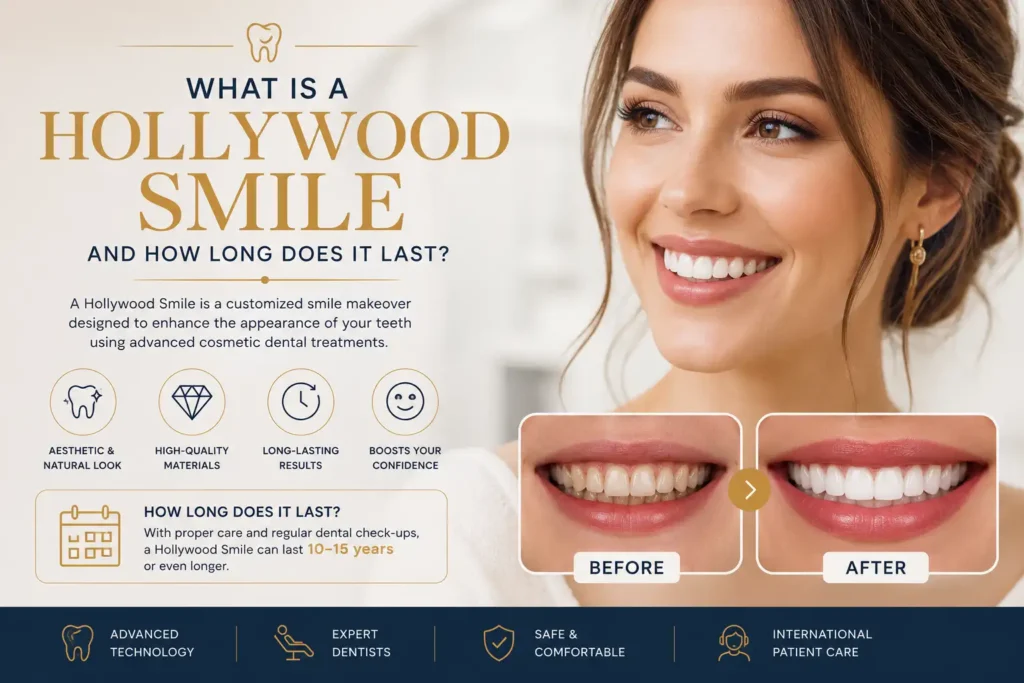
What Is a Hollywood Smile

What Is a Hollywood Smile
and How Long Does It Last?

Ever notice how certain actors and public figures have teeth that look almost suspiciously perfect? That’s usually not luck or genetics. It’s the result of a treatment the dental industry calls a Hollywood Smile, and it has quietly become one of the most searched phrases in cosmetic dentistry. Istanbul, in particular, sees a huge share of international patients travelling specifically for it.

What follows is a straightforward, medically grounded breakdown: what a Hollywood Smile actually involves, who it’s realistically suited for, which materials get used, how the procedure runs, and where the genuine limitations are. It’s the same breakdown our team at Clinic Plus One gives every patient who sits down with us for a first consultation. It’s worth saying clearly that nothing below is a promise of a particular result. A smile makeover is a personal aesthetic and clinical decision, and it can only be properly planned once a dentist has actually examined your teeth, whether in person or through a well-supported digital assessment.

Patient examining Hollywood Smile results in mirror
A confident, natural smile — the goal behind every Hollywood Smile treatment plan

What Is a Hollywood Smile?

A Hollywood Smile is not a single procedure. It is a cosmetic smile makeover that combines two or more treatments — most commonly porcelain or E-max veneers, zirconia crowns, professional teeth whitening, and gum contouring — to create a brighter, more symmetrical, and naturally proportioned smile.

The name originates from the entertainment industry, where actors have used veneers to achieve camera-ready smiles since as early as the 1930s. Today, the same techniques are available through modern cosmetic dentistry, planned around each patient’s facial proportions, lip line, skin tone and existing bite, rather than applied as a one-size-fits-all template.

A responsibly delivered Hollywood Smile is built on Digital Smile Design (DSD) — a digital preview process — combined with careful material selection and minimally invasive tooth preparation wherever possible.

What Does a Hollywood Smile Actually Include?

Depending on the individual case, a Hollywood Smile treatment plan may combine:

  • Porcelain or E-max (lithium disilicate) veneers — thin shells bonded to the front surface of the teeth
  • Zirconia or ceramic crowns — used on teeth that need more structural reinforcement, such as those with large fillings or previous root canal treatment
  • Professional teeth whitening — to match the shade of natural, untreated teeth to the new restorations
  • Gum contouring (gingival reshaping) — to correct an uneven or overly prominent gum line
  • Composite bonding — a more affordable, less invasive option for minor corrections

Not every patient needs all of these. A dentist determines the right combination based on tooth condition, gum health, and aesthetic goals — not a fixed package.

Natural Appearance

Strong &
Durable

Improve
Chewing

Preserve
Jawbone

Boost
Confidence

Who Is a Good Candidate for a Hollywood Smile?

Good candidates typically want to improve one or more of the following:

  • Tooth discolouration that does not respond well to whitening alone
  • Gaps or spacing between teeth
  • Worn, chipped, or uneven tooth edges
  • Mildly crooked or irregularly shaped teeth
  • An uneven or asymmetrical gum line
  • General smile aesthetics ahead of a major personal or professional event

Ideal candidates also have reasonably healthy gums and teeth free from active decay, since underlying dental problems should be treated before cosmetic work begins. Patients with significant misalignment may be advised to consider orthodontic treatment such as Invisalign or braces first, either instead of veneers or in combination with them, depending on the case.

A dentist can only confirm candidacy after examining intraoral photographs, X-rays, and in many cases a 3D digital scan.

When Might a Hollywood Smile NOT Be Recommended?

A responsible clinic will also explain when this treatment is not the right first step:

  • Active gum disease or untreated tooth decay, which must be addressed before veneers or crowns are placed
  • Severe misalignment or bite problems, which may require orthodontic treatment first
  • Bruxism (teeth grinding) that is not yet managed with a night guard, as this significantly increases the risk of chipped or debonded veneers
  • Very thin natural enamel, which may limit how much preparation the teeth can safely tolerate
  • Unrealistic expectations — for example, expecting veneers to correct significant functional bite issues rather than aesthetics alone

Veneer and Crown Materials: What Are the Differences?


Material choice has a major impact on both appearance and longevity. The table below summarises the options most commonly used in modern smile makeovers.

MaterialTypical LifespanKey Characteristics
E-max (lithium disilicate)15-20+ yearsHighly translucent, closely mimics natural enamel, strong enough for most veneers and single crowns
Zirconia10-15+ yearsExtremely durable, ideal for crowns or patients needing extra strength, slightly less translucent than E-max
Feldspathic porcelain10-15 yearsExcellent light transmission, historically used for the most natural-looking veneers, more technique-sensitive
Composite bonding5-7 yearsMore affordable and reversible, but less durable and more prone to staining over time

No material is “permanent.” All restorations have a realistic lifespan, and all porcelain or ceramic veneers involve removing a thin layer of enamel, which means the tooth will always require some form of coverage once prepared.

Step-by-Step: How the Procedure Works

  1. Initial consultation and photographic/digital assessment — often started remotely before travel
  2. Comprehensive oral examination, including X-rays, to rule out decay or gum disease
  3. Digital Smile Design (DSD) — a preview simulation showing the expected shape, shade and proportions
  4. Treatment planning — deciding which teeth need veneers, crowns, whitening, or gum contouring
  5. Minimal tooth preparation — a thin layer of enamel is removed under local anaesthesia (composite bonding may require little or no preparation)
  6. Digital or traditional impressions of the prepared teeth
  7. Temporary restorations are fitted while the final veneers/crowns are custom-made in a dental laboratory
  8. Try-in and shade verification before permanent cementation
  9. Final placement and bonding of the veneers or crowns
  10. Bite adjustment and polishing, followed by aftercare instructions

Most international patients complete this process within a 5 to 8 day visit, though more complex cases involving implants or extensive orthodontic correction may require a second visit months later.

Hollywood Smile Istanbul
Digital Smile Design mapping ideal tooth proportions onto a patient’s own smile

Digital Technology Used in Smile Design

  • Digital Smile Design (DSD) software, which overlays a proposed smile onto a patient’s own facial photos
  • Intraoral scanners, replacing traditional impression putty for a more comfortable, accurate digital mould
  • CAD/CAM milling systems, used to produce precise zirconia crowns in-house or through partner laboratories
  • Shade-matching technology, to align new restorations with the patient’s natural, unwhitened teeth

These tools improve predictability and communication between patient and dentist, but the simulated preview is a planning aid — the final clinical result depends on tooth anatomy, gum response, and laboratory execution, and can vary from the digital mock-up.

Recovery and What to Expect Afterward

Timeframe What to Expect
Day 1-3 Mild gum tenderness and tooth sensitivity, particularly to hot or cold
Week 1-2 Sensitivity typically fades; patients adapt to the new bite and tooth shape
Week 2-3 Any residual sensitivity from tooth preparation usually resolves without treatment
Month 1+ Full adaptation to speech and chewing; follow-up review recommended

Local anaesthesia is used during tooth preparation, so the procedure itself should not be painful, though some post-treatment sensitivity is normal and expected.

Aftercare: Making a Hollywood Smile Last

  • Wear a night guard if you grind or clench your teeth — this is one of the single biggest factors in preventing veneer fracture or debonding
  • Avoid biting very hard foods directly with front veneers (ice, hard sweets, unshelled nuts)
  • Maintain daily brushing and flossing, including around crown and veneer margins
  • Attend six-monthly dental check-ups and professional cleanings
  • Avoid using teeth as tools (opening packaging, biting nails)
  • Ask your dentist about touch-up whitening intervals, since whitening results fade gradually while veneers retain their shade far longer

Risks and Limitations

Every dental procedure that alters tooth structure carries some risk. Patients should understand that:

  • Tooth preparation is generally irreversible. Once enamel is removed for a veneer or crown, the tooth will always need some form of restoration
  • Veneers and crowns can chip, crack or debond, particularly under grinding, trauma, or biting very hard objects
  • Post-treatment sensitivity is common in the days and weeks following preparation and usually resolves, but occasionally persists longer
  • Gum irritation can occur temporarily around new restoration margins
  • Colour and shape are a clinical judgement, and while digital previews help, the final in-mouth result depends on the patient’s underlying anatomy and the skill of the dental technician
  • No material lasts forever — veneers and crowns will eventually need replacement, typically after 10–20 years depending on material and care

A trustworthy clinic will discuss these limitations honestly rather than presenting a smile makeover as a risk-free or permanent solution.

Common Mistakes Patients Make

  1. Choosing a material based on marketing claims rather than what actually suits your teeth — composite, feldspathic, E-max and zirconia behave very differently and last very differently
  2. Assuming a digital smile design preview is a guaranteed final result
  3. Not disclosing teeth grinding (bruxism) before treatment, increasing the risk of early veneer failure
  4. Requesting more tooth reduction than necessary for the sake of maximum whiteness or uniformity, which increases irreversible enamel loss
  5. Skipping the night guard after treatment
  6. Not asking what the warranty actually covers, and for how long
  7. Booking treatment without addressing existing gum disease or decay first

Getting a Personalised Treatment Plan

No two smile makeovers are the same. The right combination of veneers, crowns, whitening and gum contouring depends on your tooth condition, your gum health, your facial proportions, and what you’re actually hoping to change, not a fixed package applied to every patient who walks in. At Clinic Plus One, we build every Hollywood Smile plan around your own digital smile design and a real clinical exam first. You’ll know exactly which material is being recommended for which tooth, and why, before anything is finalised in writing. We’d rather spend extra time getting that right than rush you toward a decision.

Hollywood Smile before and after transformation Turkey
A real Hollywood Smile transformation, planned around the patient’s own facial proportions

Why International Patients Choose Istanbul for Smile Makeovers

  • High case volume, giving many cosmetic dentists in the city extensive hands-on experience with veneer and crown cases
  • Access to modern digital workflows, including DSD, intraoral scanning and in-house CAD/CAM milling
  • Coordinated international patient support, including translators, transfers and multi-day treatment scheduling
  • The ability to combine treatment with a visit to a major global city

As with any cosmetic dental decision, patients should conduct independent due diligence — verifying dentist qualifications, confirming the exact material being recommended, and reading a broad range of patient reviews rather than relying solely on a clinic’s own marketing.

Frequently Asked Questions

  1. How long does a Hollywood Smile last? It really comes down to material. E-max veneers tend to hold up 15–20+ years, zirconia crowns around 10–15+ years, and composite bonding is the shortest-lived at roughly 5–7 years. Good aftercare pushes all of these toward the higher end.
  2. Is a Hollywood Smile painful? No, not during the procedure itself, since tooth preparation is done under local anaesthesia. Afterward, mild sensitivity for a week or two is common and usually fades on its own without any treatment.
  3. How many teeth are included in a Hollywood Smile? This varies by patient. A partial smile may involve 6–10 teeth, while a full smile makeover typically covers 16–20 visible teeth for a uniform result across both arches or the upper arch alone.
  4. What is the difference between veneers and crowns? Veneers cover only the front surface of a tooth and require minimal preparation. Crowns encase the entire tooth and are used when more structural support is needed, such as after a root canal or with large existing fillings.
  5. Can a Hollywood Smile fix crooked teeth? Veneers can mask mild misalignment, but significant crowding or bite problems are usually better addressed with orthodontic treatment such as Invisalign or braces, sometimes combined with veneers afterward.
  6. Is the treatment reversible? No. Because a thin layer of enamel is typically removed to fit veneers or crowns, the process is considered irreversible — the tooth will always need some form of restoration going forward.
  7. How many trips to Istanbul are usually needed? Most straightforward veneer or crown cases are completed in one visit of 5–8 days. Cases involving implants or orthodontics beforehand may require a second visit months later.
  8. What happens if a veneer chips or comes loose? Reputable clinics offer a warranty period for repairs or replacement. Ask in writing what is covered, for how long, and how remote aftercare or follow-up claims are handled if you are back home.
  9. Will my Hollywood Smile look fake or too white? A well-planned treatment uses shade matching and digital design to create a natural-looking result suited to your skin tone and facial proportions, rather than an artificially uniform “veneer white.” Final aesthetics depend on your dentist’s technique and the laboratory’s work.
  10. Do I need a night guard after treatment? If you grind or clench your teeth, a night guard is strongly recommended, since bite forces on thin ceramic material are one of the leading causes of chipping or debonding.
  11. Can I combine a Hollywood Smile with teeth whitening? Yes. Whitening is often carried out on natural, untreated teeth before veneer shade selection, so that the final restorations match the surrounding teeth.
  12. What can I expect from a consultation with Clinic Plus One? A proper look at your teeth and gums first, a conversation about what you actually want to change, and a digital smile design built around your own face rather than a generic template. You’ll leave with a clear, written plan, not a sales pitch.

Final Thoughts

It’s easy to treat a Hollywood Smile like a simple purchase: pick a clinic, book a date, done.
But the enamel that gets removed to fit a veneer doesn’t grow back, which makes this a
permanent decision dressed up as a cosmetic one. Good outcomes tend to trace back to the
same few things every time: an honest diagnosis, the right material for your specific teeth,
and expectations that match what dentistry can actually deliver rather than what a digital
mock-up shows. That’s the standard we hold ourselves to at Clinic Plus One, and it’s a fair
standard to expect from any clinic you’re considering.
If you’re weighing this up, get a written plan first. Find out exactly which material you’re
being recommended and why, and what the clinic’s warranty looks like if a veneer chips two
years from now. Clinics that do good work tend to answer these questions without hesitation.

Call to Action

Thinking about a smile makeover? Book a consultation with Clinic Plus One and we’ll give
you an honest read on your case, not a generic package. We’ll walk you through which
combination of treatments actually makes sense for your teeth and what you’re hoping to
achieve, plus a clear, written plan. There’s no obligation attached.

Medical Disclaimer

This article is provided for general educational purposes only and does not constitute
medical or dental advice. It is not a substitute for a professional clinical examination.
Suitability for veneers, crowns, or any smile makeover treatment, along with expected
outcomes and material recommendations, can only be determined by a qualified dentist
after reviewing your oral health, dental history and diagnostic imaging in person or via
appropriate digital assessment. Individual results vary, and no clinic can guarantee a specific
aesthetic outcome or lifespan for any restoration. Always seek the advice of a licensed
dental professional with any questions regarding a medical or dental condition or treatment.

Step 1
Smile Analysis & Planning

Digital smile design technology is used to create a personalized treatment plan.

Step 2
Tooth Preparation

Minimal tooth preparation is performed before temporary restorations are placed.

Step 3
Final Smile Placement

Custom veneers or crowns are placed to complete the smile transformation.

Personalized Hollywood Smile Treatments at Clinic Plus One

At Clinic Plus One, we provide customized Hollywood Smile treatments designed to create healthy, aesthetic, and natural-looking smiles for our international patients.

If you are considering a Hollywood Smile in Istanbul, our experienced team is ready to guide you through every step of your smile transformation journey.
Ready for Your New Smile?

Book your free consultation
with our experts.

Experience More
Than Just Treatment

Enjoy a perfect blend of world-class
dental care and unforgettable
Istanbul experience.