When someone is dealing with extensive tooth loss, advanced decay across most of the mouth, or a denture that’s never fit quite right, full mouth dental implants are usually where the conversation lands. It’s a well-established route back to a fixed set of teeth that actually functions like real teeth. This guide walks through it properly: what the treatment involves, who’s actually a good candidate, how All-on-4 differs from All-on-6, what the surgery and recovery look like, and the risks that deserve a straight answer before you book a flight.
Worth saying plainly: this is a significant surgical procedure, not a cosmetic touch-up, and nothing here replaces an actual clinical exam. Whether you qualify depends on your jawbone volume, your general health, and a proper 3D scan, none of which can be assessed from a distance.
Full mouth dental implants (also called full-arch implants) refer to implant-supported restorations designed to replace all missing or severely compromised teeth in one or both jaws. Rather than restoring one tooth at a time, a small number of strategically placed implants support an entire arch of replacement teeth.
Unlike a removable denture, which rests on the gum and can shift while eating or speaking, full mouth implants are anchored directly into the jawbone, giving a more stable, natural-feeling result. Common approaches include:
Full mouth implant treatment may be appropriate for patients who have:
As with single-tooth implants, candidacy depends on bone density, gum health, and general medical status — particularly whether diabetes, smoking, or certain medications could affect healing. A dentist confirms suitability only after reviewing CBCT (3D imaging), never from photographs alone.

As with any implant treatment, no clinic can guarantee a specific outcome or survival rate for an individual patient — published rates reflect population-level data from specific studies and protocols, not a personal promise.
| Factor | All-on-4 | All-on-6 |
|---|---|---|
| Number of implants per arch | 4 | 6 |
| Best suited for | Adequate bone volume, straightforward cases | Lower bone density, higher bite force needs, added redundancy |
| Load distribution | Concentrated across 4 implants | Distributed across 6 implants |
| If one implant fails | Fewer remaining implants to support the arch, may require more urgent attention | More implants remain to support the prosthesis while the issue is addressed |
Neither option is universally “better” — the right choice depends on individual bone quality, bite force, and the dentist’s clinical judgement, not marketing preference.

Because full osseointegration takes months, most international patients complete full mouth implant treatment across two visits: an initial visit for extractions, implant placement and temporary teeth, followed by a second visit later for the final prosthesis.
These tools materially improve planning accuracy but remain decision-support technology — final suitability and execution depend on the surgeon’s clinical judgement.
| Timeframe | What to Expect |
|---|---|
| Day 1–3 | Swelling and discomfort, typically more pronounced than single-implant cases, managed with prescribed medication |
| Week 1–2 | Swelling gradually subsides; soft-food diet strongly recommended |
| Month 1 | Adaptation to temporary fixed teeth; follow-up check advised |
| Month 3–6 | Osseointegration typically complete in most patients, confirmed before final prosthesis |
| Month 6+ | Final fixed prosthesis fitted and adjusted |
Recovery pace varies significantly by patient. Smoking, uncontrolled diabetes, and poor oral hygiene can meaningfully extend healing time.

A responsible clinic will discuss these risks honestly rather than presenting full-arch implants as guaranteed or risk-free.
A full-arch case is too significant to plan from a template. At Clinic Plus One, every full mouth implant plan starts with a detailed CBCT scan and an honest look at whether All-on-4 or All-on-6 genuinely fits your bone, not whichever is easier to package. You’ll get that reasoning explained to you directly, along with a written plan covering the implant brand, the number of implants, and what our follow-up and revision policy actually covers.
As always, independent due diligence matters: verify surgeon qualifications, confirm the implant brand in writing, and read a broad range of patient reviews rather than relying solely on a clinic’s own marketing.

1. How many implants are needed for a full mouth restoration? Usually four per arch (All-on-4) or six (All-on-6), though some patients need more depending on bone quality and how much bite force the case has to handle. Your dentist won’t know for sure until the CBCT scan is done.
2. Can I get fixed teeth on the same day as surgery? Often, yes, provided the bone density and implant stability are there to support it. But it’s not something any clinic can promise in advance. That call gets made during surgery itself, once the surgeon can see how stable the implants are.
3. How long do All-on-4 or All-on-6 implants last? Published studies report 10-year survival rates generally in the 93–98% range, and long-term data extending to 13–18 years shows continued favourable outcomes in appropriately selected, well-maintained cases. Individual results vary.
4. Is full mouth implant surgery painful? The procedure is performed under local anaesthesia, often with sedation available for anxious patients. Post-surgical swelling and discomfort for several days is normal and managed with medication.
5. What happens if I don’t have enough jawbone? Depending on the degree of bone loss, options include bone grafting, sinus lifts, or zygomatic implants for severe upper jaw bone loss. Your dentist will confirm the most suitable option after imaging.
6. How many trips to Istanbul are required? Typically two visits: one for extractions (if needed), implant placement, and temporary teeth, and a second visit 3 to 6 months later for the final fixed prosthesis once healing is confirmed.
7. What is the difference between All-on-4 and a removable implant-supported denture? All-on-4 typically provides a fixed, non-removable prosthesis. An implant-retained overdenture is removable by the patient but clips onto implants for improved stability compared with a conventional denture.
8. What happens if one implant fails? With All-on-4, losing one implant affects the arch’s support more significantly, since only three remain. With All-on-6, five implants can often continue supporting the prosthesis while the affected one is addressed. Reputable clinics should explain their revision and warranty policy in writing.
9. Are full mouth implants suitable for diabetic patients? Often yes, provided diabetes is well controlled. Uncontrolled diabetes significantly increases infection risk and impairs healing, so coordination with your physician beforehand is important.
10. How do I clean a fixed full-arch implant bridge? Your dental team will recommend specific tools, often including water flossers, interdental brushes, and specific floss threaders, since a fixed bridge cannot be removed for daily cleaning the way a denture can.
11. Can smoking affect the success of full mouth implants? Yes. Studies associate smoking with a substantially increased risk of implant failure and peri-implantitis, making smoking cessation one of the most impactful steps a patient can take to protect their investment.
12. What’s different about getting full mouth implants through Clinic Plus One? Mainly that we won’t put you into an All-on-4 or All-on-6 protocol until your CBCT scan actually supports it. We’d rather take an extra consultation to get the plan right than rush you into surgery on day one.
This is major surgery dressed up as a lifestyle decision, and it’s worth treating it that way. The clinical outcomes for All-on-4 and All-on-6 are genuinely well-documented at this point, and Istanbul’s surgical teams get a lot of case volume, which counts for something. But none of that replaces the basics: a proper CBCT scan before anything is decided, an honest conversation about which technique actually fits your bone, and a surgeon who tells you the real risks rather than just the highlights.
Ask for the full treatment plan before you commit to anything, ideally one grounded in your own scan rather than a generic package. Get the implant brand in writing. Understand what’s covered if something needs revisiting a year down the line. That’s what a written plan from Clinic Plus One will always spell out clearly.
If full mouth implants are the direction you’re heading, book a consultation with Clinic Plus One before committing to anything. We’ll go through your specific case, be straight with you about All-on-4 versus All-on-6 for your bone and bite, and hand you a written plan you can actually read. No pressure to proceed after that.
This article is provided for general educational purposes only and does not constitute medical or dental advice. It is not a substitute for a professional clinical examination. Suitability for full mouth dental implants, including technique selection, number of implants, and expected outcomes, can only be determined by a qualified dentist or oral surgeon after reviewing your medical history, oral health, and 3D diagnostic imaging in person. Individual results and healing times vary, and no clinic can guarantee a specific outcome or implant survival rate for any individual patient. Always seek the advice of a licensed dental professional with any questions regarding a medical or dental condition or treatment.
Advanced imaging technologies are used to evaluate bone structure, oral health, and smile aesthetics.
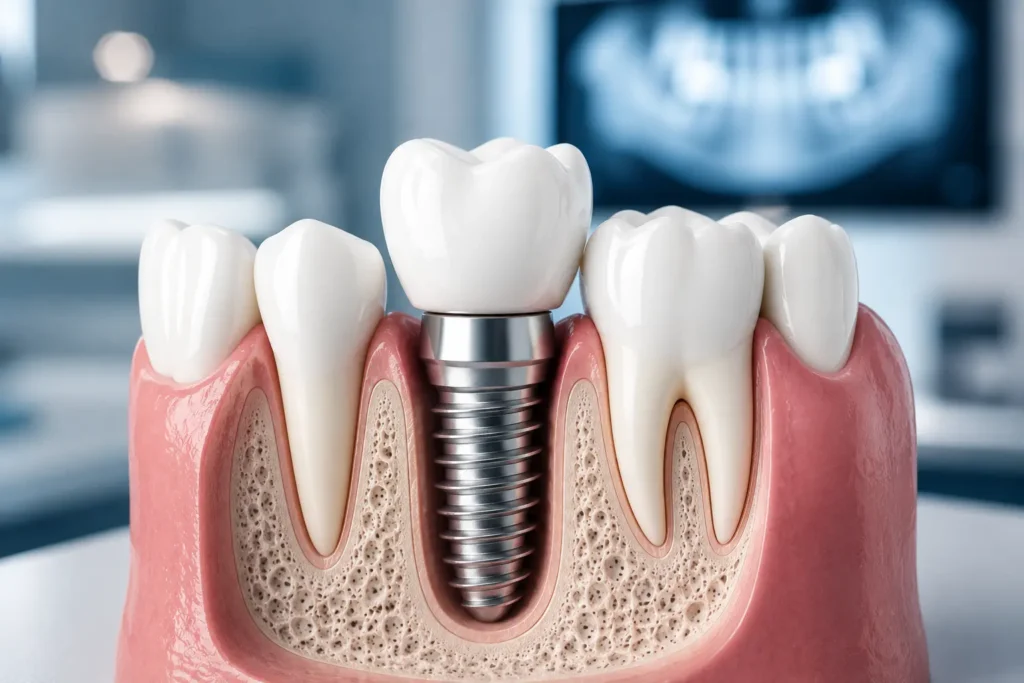
Dental implants are surgically placed into the jawbone to create a stable foundation for the new teeth.
Custom implant-supported prosthetic teeth are attached to complete the smile restoration.
At Clinic Plus One, we combine advanced implant technologies, personalized treatment planning, and aesthetic dentistry expertise to create healthy, functional, and natural-looking smiles for our international patients.
If you are considering full mouth dental implants in Istanbul, our experienced team is ready to guide you through every step of your smile transformation journey.
May 13, 2025

Enjoy a perfect blend of world-class
dental care and unforgettable
Istanbul experience.