For patients missing most or all of their teeth in one or both jaws, All-on-4 has become one of the most requested implant techniques worldwide — and one of the most searched treatments among international patients considering dental care abroad. Unlike traditional implant treatment, which can require six or more implants per arch, All-on-4 uses just four strategically placed implants to support a full fixed arch of teeth, often with a provisional set fitted on the same day.
In this guide, we explain exactly how All-on-4 works, who is a good candidate, what the procedure and recovery actually involve, and answer the questions international patients ask most often before booking treatment.
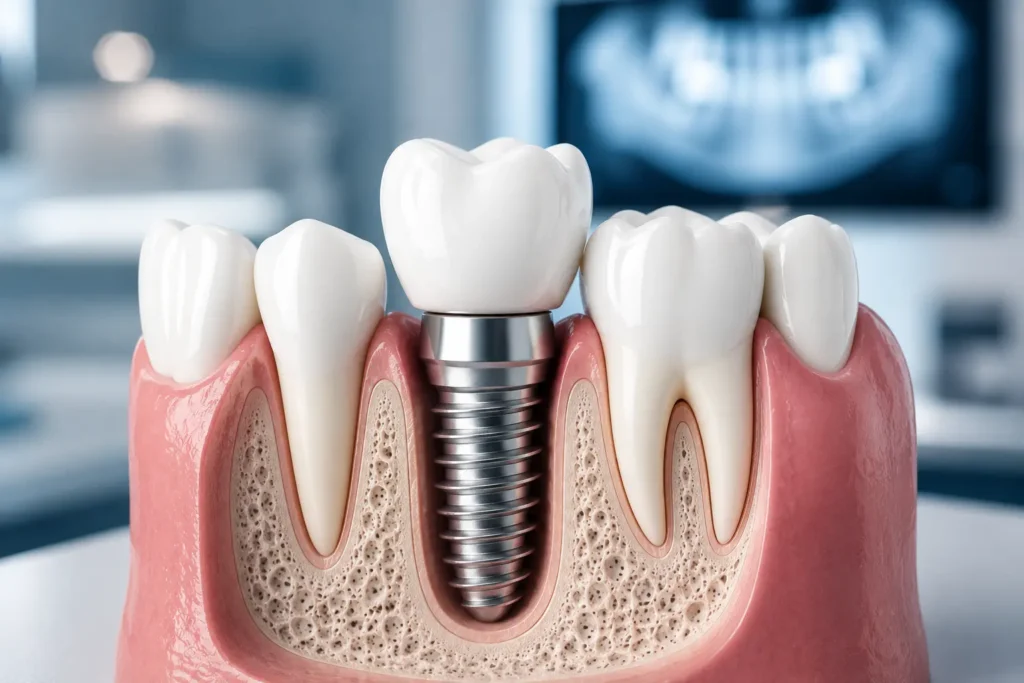
All-on-4 is an implant-supported full-arch restoration technique. Instead of replacing each missing tooth individually, four dental implants are placed in specific positions in the jawbone — typically two positioned vertically at the front and two angled at the back to maximise contact with available bone. A full fixed bridge of teeth is then attached to these four implants, replacing an entire arch.
This angled placement is what makes All-on-4 particularly suitable for patients who have experienced bone loss, since it often reduces or eliminates the need for a separate bone graft that traditional implants might require.
All-on-4 is generally suitable for patients who:
A full clinical assessment, including 3D imaging of the jawbone, is always required to confirm candidacy — All-on-4 is not automatically suitable for every patient, and your clinician may recommend an alternative approach depending on your bone structure and oral health.
| Factor | All-on-4 | Traditional Implants (Full Arch) |
|---|---|---|
| Number of implants per arch | 4 | 6-8, sometimes more |
| Bone grafting typically needed? | Often avoided due to angled placement | More commonly required if bone loss is present |
| Same-day provisional teeth | Frequently possible | Less common, healing period usually required first |
| Best suited for | Patients with some bone loss wanting a faster fixed solution | Patients with strong, sufficient bone density |
All-on-4 is technically one specific approach within the broader category of full mouth dental implants. The key distinction is the number and positioning of implants used, and the fact that All-on-4 is specifically designed to often allow a fixed provisional bridge to be fitted on the same day as implant placement, rather than requiring a longer waiting period beforehand.
Your clinician will help determine whether All-on-4, a different implant count, or another restoration approach is the right fit for your specific case.

A detailed CT scan or 3D imaging is taken to assess your jawbone structure, remaining teeth (if any), and overall oral health. This determines the exact implant positions and whether All-on-4 is the right approach for you.
If you still have remaining unhealthy or unsalvageable teeth in the arch being treated, these are typically extracted during the same procedure as implant placement.
Four implants are surgically placed into the jawbone — two at the front and two angled towards the back — under local anaesthesia or sedation, depending on the clinic and patient preference.
In many cases, a provisional fixed bridge can be attached to the implants on the same day, allowing patients to leave with a functional, natural-looking set of teeth while the implants heal.
Over the following months, the implants gradually fuse with the jawbone in a process called osseointegration. This is what gives All-on-4 restorations their long-term stability.
Once healing is complete, the provisional bridge is replaced with a final, custom-made permanent bridge, precisely fitted to your bite and aesthetic preferences.
Modern All-on-4 treatment relies heavily on digital planning. 3D cone-beam CT scans allow the clinical team to map out exact implant positions before surgery, reducing guesswork and improving precision. Some clinics also use guided surgery templates, 3D-printed from the digital plan, to help place implants with a high degree of accuracy during the procedure itself.
| Stage | Typical Timeframe |
|---|---|
| Initial swelling and soreness | 3-7 days |
| Soft food diet recommended | 4-8 weeks |
| Return to normal daily activities | 3-5 days (with some restrictions) |
| Full osseointegration | 3-6 months |
| Final permanent bridge fitted | After full healing is confirmed, typically 4-6 months |
Recovery times vary based on individual healing, bone quality, and overall health. Your clinician will provide a personalised timeline.
Caring for All-on-4 implants involves a combination of daily hygiene and regular professional check-ups:

All-on-4 candidacy depends entirely on your individual bone structure, oral health, and treatment goals. Before committing to treatment, request a full written plan that includes your 3D scan results, the exact number and brand of implants recommended, whether same-day provisional teeth are possible in your case, the estimated timeline to your final bridge, and the aftercare and guarantee terms.
Istanbul has become a leading destination for All-on-4 treatment among international patients, thanks to experienced implant specialists, modern 3D imaging and guided surgery technology, and treatment packages designed specifically around the needs of patients travelling from abroad. At Clinic Plus One, our team guides international patients through every stage of All-on-4 treatment, from the initial 3D assessment to long-term aftercare once you’re back home.
Four implants per arch, positioned to maximise support from the available jawbone — two straight at the front and two angled at the back.
In many cases, yes — a fixed provisional bridge can often be attached the same day as implant placement, though this depends on your individual case.
The procedure is performed under anaesthesia or sedation, so discomfort during surgery is minimal. Some soreness and swelling in the days afterward is normal and manageable with prescribed medication.
With proper care and regular check-ups, All-on-4 implants can last many years, though the provisional and final bridges may need replacement or adjustment over time.
Often not, because the angled back implants are specifically designed to make use of available bone and avoid areas with more significant loss. However, some cases still require grafting — this is determined during your 3D assessment.
Many patients complete the implant placement and provisional bridge in one visit, then return several months later for the final permanent bridge once healing is complete.
Your clinician will advise on safe timing based on your individual healing and any sedation used. This is typically a few days after the procedure.
Implant failure is uncommon in well-selected candidates but can happen. Reputable clinics offer guarantees and will discuss revision options if this occurs.
Age alone doesn’t rule out All-on-4 — overall health, bone quality, and healing capacity matter more than age. Your clinician will assess this individually.
Unlike removable dentures, All-on-4 results in a fixed bridge that is permanently attached to implants — it doesn’t need to be removed at night and functions much more like natural teeth.
After the initial soft-food healing period, most patients return to a largely normal diet, though very hard or sticky foods are generally best avoided long-term to protect the restoration.
This is determined through a 3D scan and clinical assessment of your bone structure, remaining teeth, and treatment goals. A qualified implant specialist will recommend the most appropriate option for your specific case.
All-on-4 has become one of the most widely chosen solutions for patients missing most or all of their teeth, offering a fixed alternative to dentures with a shorter treatment timeline than many traditional implant approaches. As with any implant procedure, success depends on proper candidacy assessment, an experienced clinical team, and committed aftercare — take the time to ask questions and request a full written treatment plan before booking.
Book your free online consultation with Clinic Plus One and find out if All-on-4 is the right treatment for you.
Medical Disclaimer: This article is for general informational purposes only and does not constitute medical advice. Candidacy, treatment approach, and recovery timelines vary by individual case. Always consult a qualified dental professional for a personal assessment before making any treatment decisions.


Advanced imaging technologies are used to evaluate bone structure, oral health, and smile aesthetics.
Dental implants are surgically placed into the jawbone to create a stable foundation for the new teeth.
Custom implant-supported prosthetic teeth are attached to complete the smile restoration.
At Clinic Plus One, we combine advanced implant technologies, personalized treatment planning, and aesthetic dentistry expertise to create healthy, functional, and natural-looking smiles for our international patients.
If you are considering full mouth dental implants in Istanbul, our experienced team is ready to guide you through every step of your smile transformation journey.
May 13, 2025

Enjoy a perfect blend of world-class
dental care and unforgettable
Istanbul experience.